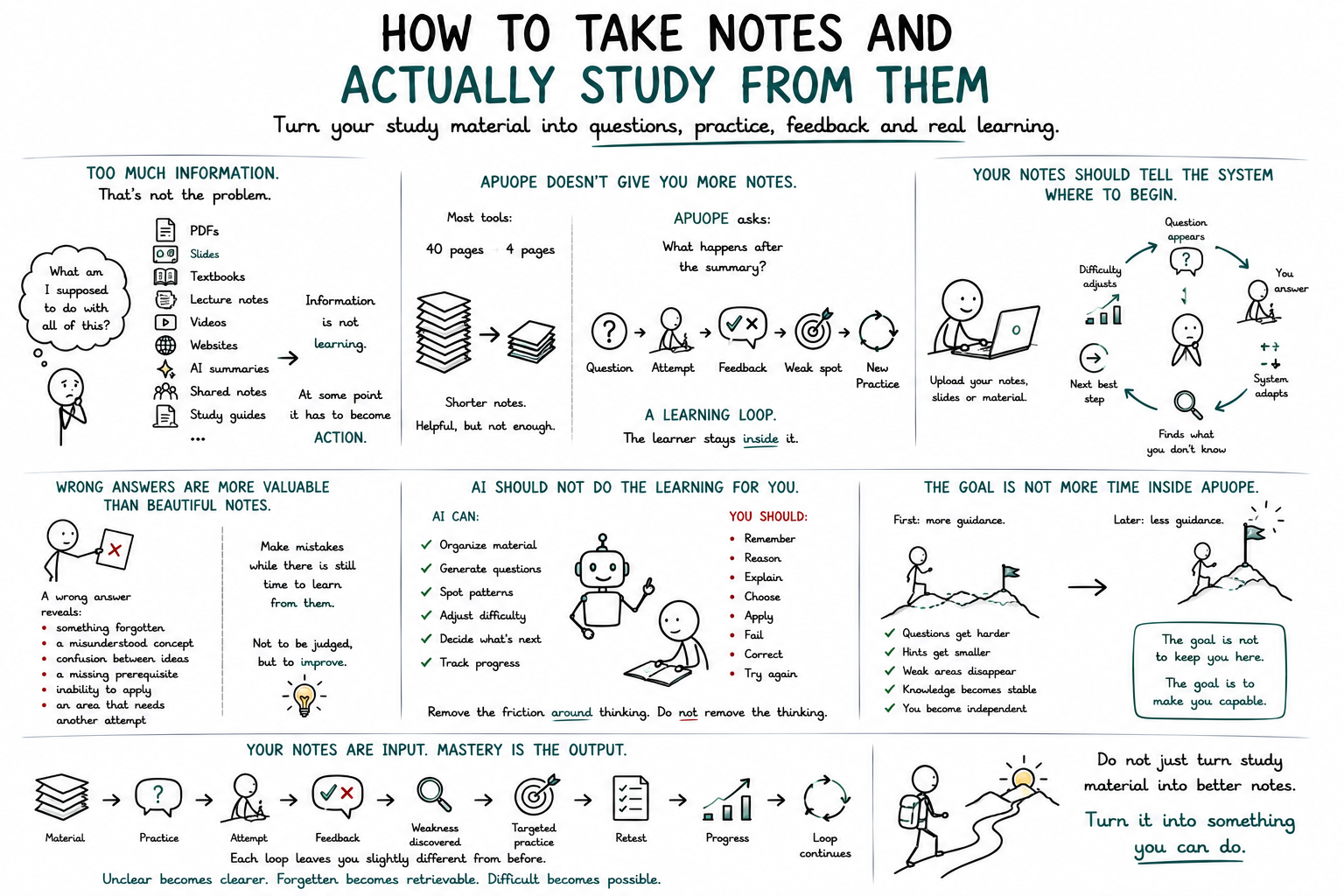
Turn your study material into questions, practice, feedback and real learning.
From Study Material to Practice
This is where APUOPE sees the bigger problem.
Students are not suffering from a lack of information.
They have more information than almost any generation before them.
PDFs.
Slides.
Textbooks.
Lecture notes.
Videos.
Websites.
AI-generated summaries.
Shared notes.
Study guides.
The problem is increasingly:
What am I supposed to do with all of this?
A folder full of material is not a learning process.
Neither is a perfectly organized notebook.
Neither is an AI summary.
At some point, information has to become action.
You have to answer something.
Explain something.
Remember something.
Apply something.
Get something wrong.
Correct it.
And try again.
That transition — from having material to practicing knowledge — is where APUOPE is focused.
APUOPE Does Not Want to Give You More Notes
There are already plenty of tools that can make your notes shorter.
Upload a document.
Get a summary.
Generate bullet points.
Extract the important concepts.
Those features can be useful.
But APUOPE starts from a different question:
What should happen after the summary?
Because eventually the learner has to stop receiving information and start producing it.
Instead of simply turning:
40 pages → 4 pages
the more interesting transformation is:
material → question → attempt → feedback → weak spot → new practice
That is a learning loop.
And the learner remains inside it.
Your Notes Should Tell the System Where to Begin
Imagine uploading your own notes, lecture slides or study material.
The objective should not be for AI to admire, rewrite or endlessly summarize them.
The material should become the starting point for discovering what you actually know.
A question appears.
You answer it.
Maybe correctly.
Maybe incorrectly.
Either outcome creates information.
If you understand the topic, the system can move forward.
If your answer reveals uncertainty, it can probe deeper.
If a prerequisite seems to be missing, it can move backward.
If you repeatedly succeed, the difficulty can increase.
If something keeps causing problems, it should return.
The notes provide the map of what could be learned.
Your answers provide the map of what should happen next.
That distinction is central to how APUOPE thinks about learning.
Wrong Answers Are More Valuable Than Beautiful Notes
A beautiful page tells us almost nothing about the learner.
A wrong answer can tell us a lot.
It can reveal:
- something forgotten,
- a misunderstood concept,
- confusion between two similar ideas,
- a missing prerequisite,
- an inability to apply knowledge,
- or simply an area that needs another attempt.
That means the objective should not be to prevent mistakes.
It should be to make mistakes happen while there is still time to learn from them.
Before the exam.
Before the grade.
Before the mistake becomes expensive.
This is why APUOPE treats practice differently from assessment.
The question is not there primarily to judge you.
It is there to discover what should happen next.
AI Should Not Do the Learning for You
This becomes increasingly important as AI gets better.
It is easy to imagine the ultimate AI study tool as something that does everything.
It reads the material.
Writes the notes.
Summarizes them.
Explains everything.
Answers every question.
Solves every difficult problem.
And perhaps eventually takes so much cognitive work away that the student barely has to think.
That would be an impressive AI product.
It might also be a terrible learning product.
APUOPE takes the opposite view.
AI should remove unnecessary friction around learning.
It can organize material.
Generate appropriate questions.
Recognize patterns in mistakes.
Adjust difficulty.
Decide what deserves another attempt.
Keep track of progress.
But the learner should still perform the part that creates learning.
Remember.
Reason.
Explain.
Choose.
Apply.
Fail.
Correct.
Try again.
Remove the friction around thinking. Do not remove the thinking.
The Goal Is Not More Time Inside APUOPE
There is another consequence of this philosophy.
Most digital products benefit when users spend more time using them.
More sessions.
More clicks.
More engagement.
More consumption.
Learning technology has to be more careful.
The goal should not be to make a student permanently dependent on APUOPE.
The goal should be to make the student increasingly capable.
At first, the system may need to guide heavily.
Later, less.
Questions can become harder.
Hints can become smaller.
Weak areas can disappear.
Knowledge can become more stable.
Eventually, something that once required notes, explanations and assistance can be answered independently.
From a conventional engagement perspective, that may look strange.
The system helped less.
From a learning perspective, it is exactly what should happen.
Your Notes Are Input. Mastery Is the Output.
So take notes.
Take good ones.
Write in your own words.
Capture relationships.
Save examples.
Mark what confuses you.
Turn important ideas into questions.
But do not let the notebook become the destination.
Your notes should eventually lead somewhere.
For APUOPE, that path looks roughly like this:
Material
↓
Practice
↓
Attempt
↓
Feedback
↓
Weakness discovered
↓
Targeted practice
↓
Retest
↓
Progress
And then the loop continues.
Not because the goal is to answer endless questions.
But because each loop should leave the learner slightly different from before.
Something that was unclear becomes clearer.
Something forgotten becomes retrievable.
Something difficult becomes possible.
Eventually, the material that once looked overwhelming becomes knowledge you can actually use.
That is the point of the notes.
And that is the point of APUOPE.
Do not just turn study material into better notes.
Turn it into something you can do.